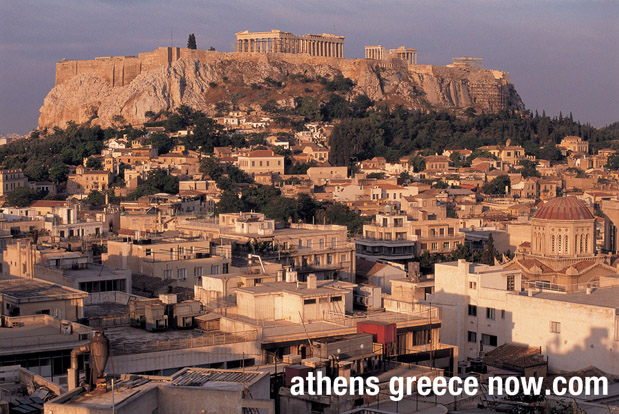
This web site is about Athens and Greece in general: the current focus is on the economic plight of the country.
The struggle in Greece to handle out-of-control public debt and the destruction it is causing is making headlines throughout the world. Many see the Greek dilemma as a template for most of the West as the pattern of financing the activities of government through borrowing has had a terrible boomerang effect on productivity and stability. The implications for the world's nations which manage their finances after this model is severe.

The Imminent Crisis - : Greek Debt and the Collapse of the European Monetary Union by Grant Wonder

Eyewitness Greece - Athens and the Mainland - 352 Pages

Financial markets and economic growth in Greece, 1986-1999 [An article from: Journal of International Financial Markets, Institutions & Money]
Living in Greece Blog (this is probably the most important english language "Greece" blog there is.)
Athen News
Perennial english language Athens paper online with classifieds, etc.
Greek news Online
From out of Astoria New York, includes wire news reporting
Phantis
Aggregate site collecting Greek news from many sources
Proto Thema
"The Lead Story" news site (in Greek)
Greek Reporter
Enlgish langauge news about events about and in Greece
Neo Kosmos is Australia's largest circulation Greek newspaper
Greece Topix
Updated regularly with Greek news. Their discussion forum is mostly an ongoing war between macodonian/albanian/greek
partisans.
US Embassy Athens
Downtown Athens.
pireas.org looks out at Athens from across the Pireas bay twenty-four hours a day. Weather station with up to the minute reporting.
nifada.org Has an excellent view of about half of Athens all the way to Pireas - page also has weather reports.
Akropolis Live View 24/7 view looking up at the walls and temple mount - Hellenic Foundation
Adrian's Gate live cam of the traffic flying by 24/7 - Hellenic Foundation
This is an archive page, see the current home page here
ARCHIVE PAGE - MAY 19 TO MAY 31 2010
ARCHIVE PAGE - MAY 1 TO MAY 18 2010
ARCHIVE PAGE - DEC 2009 - MARCH 2010

Parga in Epirus Greece. Source: Big Stock Photo
John Dizard writing at the Financial Times predicts the Greek financial future: par bands (where current bonds that cannot be honored must be exchanged with bonds that either have less value, or mature at a much longer time span with a lower coupon value) and balance sheet trickery:
"...the current plan for Greece is unlikely to survive long after the details of the European facility, or Special Purpose Vehicle, are finally agreed. These include, for example, just how “joint and several” the thing is. If Portugal or Ireland cannot borrow, even at a premium, to meet their funding obligations for the SPV, how much of the slack would Germany be obligated to pick up?
This is the kind of question nobody wants to debate in public in the middle of a Greek rescheduling. So, for now, European and Greek officials have a mutual interest in sticking to the same story.
In a few months, though, after the horrifyingly animated SPV raises itself off the operating table, the real work for the sovereign debt lawyers and bankers will begin. Their first issue, which the FT’s Gillian Tett raised last week, is how deep a cut in real value needs to be imposed on holders of Greek bonds if the country is to have a chance for sustainable recovery.
Then, once we have that number, call it 30 or 40 per cent, the reschedulers will prepare the menu of options for the “voluntary” exchange. They will just change the name at the top from “Argentina” or “Mexico” to “Greece”, and pour the bondholders some ouzo while the choices of paper offered in exchange are contemplated. ”
In related news, the credit rating agency Fitch downgraded Spain on May 28. Fitch was one of the triggers for the Greek crisis when it did the same with Athens over a month ago.
Greek tourism, already on a statistical downswing of at least 15% (some report as much as a 30% drop), is about to take another blow with a planned Greek sailor strike on May 31, 2010. The sailors are protesting the Greek government decision to allowed non-EU flagged ships to land and transport tourists between the Greek islands. The intention is to open up the tightly-controlled rights for passenger transportation in the 2,000 Greek island chain to more tourism. AOL News article by Anthee Carassava summarizes the dilemmas for both sectors of the economy in Greece:
"At this time, there is no logic in the strike action that these seamen want to follow," said George Zisimatos, a leading trade representative of Piraeus. "We all stand to suffer if they continue like this."
A rash of austerity measures, including salary freezes, bonus cuts and tax hikes, have unleashed near daily shows of protests with recurring images of rioting workers, deadly demonstrations and debilitating strikes spoiling would-be holidaymakers from travelling to Greece. This month alone, hotel cancellations capped 20,000 in the Greek capital with hoteliers in other parts of the country recording a 30 percent drop compared with last year.
...Greek seamen are to take to the country's ports Monday [May 31] to protest government plans to lift restrictions on vessels with foreign crews docking in Greece.
At least 30 ferries are due to be stranded in ports across the country while five cruise ships may be blocked from docking at Piraeus, Europe's biggest passenger port, as seamen kick off a 24-hour industrial strike early Monday.
"We are protesting against the government's policies. We have to protect our rights and our jobs," said Yannis Halas, general secretary of the Panhellenic Seamen Federation.
"It's not a protest against tourist arrivals in Greece, but they can't throw Greek seamen onto the streets. They are also offering a lot to the economy," he said.
Enet.gr also covers this story from Greece (babelfish translation to English)
It's not just the sailor strike which is hurting Greek tourism. A quick survey of travel agent blogs and web sites seems to always contain the same point: If you're going on a trip to Greece for a vacation, stay away from the trouble in Athens and head for either the isalnds or the western coast.
Not exactly good news for retailers: the Greek language news site Ta Nea has this story on (via babelfish translation) about the changing spending habits in Athens:
"...85% believe that the country is in recession, and 80% believe the situation will continue for the time being.
...An overwhelming majority are cutting unnecessary expenses, and reducing necessary spending to cheaper brands."
Saw this originally via the Living in Greece blog
Kathimerini editorial focuses on the dwindling confidence of voters with Papandreou's government. While simultaneously meeting the requirements of the IMF--backed bailout, the government is trying to run corruption investigations (for example the Siemans bribery case) and to squelch the secret deals that seems to have been the backbone of government decision making in the past:
"It is not just the Greek state that is teetering on the brink of collapse, but the entire political system. The combination of inefficient management and widespread corruption has dealt a serious blow to its credibility.
The political crisis, furthermore, comes at a time when the country faces the risk of defaulting on its loans if it fails to implement the austerity measures imposed by the International Monetary Fund and the European Union.
Greece needs strong governance, not the kind of leadership it has seen in the past years or even in the past months.
While the government’s drive to resolve pending corruption cases is commendable, it should be wary about turning the political body into an anarchic maelstrom of mutual recriminations."
Michael Brabant for the BBC is covering the fight between european drug companies owed over a billion euros and the Greek government which has decreed a unilateral reduction in pricing.
"The decision by Leo Pharma to suspend distribution of an anti blood-clotting agent and a remedy for psoriasis takes Greece one step closer towards an all-out boycott by medical suppliers.
Kristian Hart Hansen, a senior director of the company, said the 25% price reduction would encourage similar moves in other countries with large debt problems such as Ireland and Italy.
He warned that unless the company took action, there would job losses across Europe, including Denmark where the company is based.
Earlier this week another Danish company, Novo Nordisk, withdrew sales of its state-of-the-art insulin product from Greece for the same reason.
...The Greek government has promised to repay 5.6bn euros that it owes to medical companies for hospital equipment and drugs.
But the Greek Association of Science and Health Providers has warned that there is little chance of an agreement and that the country's debt-plagued state hospitals face a supply embargo.
A spokesman for Novo Nordisk, which is owed 24.4m euros by Greece, said that the debt issue was unrelated to the decision not to lower prices. ”
I've been looking for more information on this. The Greek government is claiming these companies have exploited the Greek market and have been overcharging Greeks compared to other countries. Or is this a leverage tool by the Greek government to pressure the Pharmaceutical companies to negotiate on the outstanding debt of over a billion euros? The immediate creation of a black market for basic drug supplies doesn't help Greece, already suffering from growing grey markets operating off the revenue collection radar of the government.
A basic premise of an operating socialist country is the open- to-all healthcare system. Deprived of tools, how can that part of the system survive? An island country like Cuba is surrounded by water, the US embargo, and the hyper-control of a dictatorship. Greece isn't contained like this, and the pressures of life-saving drugs being blocked should have serious consequences on the both the future of the present government rulership, and the process of implementing the austerity program, along with the implications for to the many other creditors looking to Athens for payment on debt.

So says Pacific Investment Management Co.’s Bill Grossat Bloomberg Businessweek. (PIMCO is an investment company and runs the Total Return fund, the world’s largest mutual fund.)
"...restrictive lending rates and austerity measures that slow growth will leave Greece with “no way out” of a debt restructuring. “The growth required in order to shoulder Greece’s debt burden is so excessive and the fiscal restrictiveness being imposed on the country is so restrictive they there will be no way out,” Gross said, in an interview with Bloomberg Television. “Restructuring at some point down the road -- perhaps a year or two years down the road -- will take place.”
... Nobel Prize-winning economist Robert Mundell said reworking debt may be “inevitable” for one or two countries that share Europe’s common currency in the next five years.
“Debt restructuring may be needed for one or two fiscally weak euro members,” he said today at a conference in Warsaw. “In five years it may be inevitable, but it doesn’t mean euro deconstruction, it just means debt restructuring.”

Kathimerini on the 'human error' that left Papandreou's home without phone service for seven days:
"Telecommunications engineers accidentally cut off the telephone line to the home of Prime Minister George Papandreou, in the northern Athens suburb of Kastri, the CEO of OTE telecom, Panagis Vourloumis, said yesterday. In a statement, OTE telecom said that Papandroeu's line remained disconnected for seven days after it was cut off "due to human error."
According to sources, the engineers had been trying to cut the telephone line of a customer who was behind in payments. The phone number of the customer in arrears was the same as that of the premier, save for one digit, the sources said."
A highway was closed down to make way for an amphibian migration. This from Stephen Williams at the New York Times:
"As if the political and economic tumult wasn’t enough to rattle the people of Greece, little frogs — “millions,’ according to the police chief of Thessaloniki, Giorgos Thanoglou — closed one of the country’s major highways for more than two hours on Wednesday, according to The Associated Press."
When I was a kid living just outside Athens, I would take tadpoles from the mudpuddles and temporary ponds from spring rains and keep them in containers under my bed. The idea was to witness their transformations into frogs, but the last time I did this I forgot they were there for a few days and was finally awoken in the middle of the night to their sticky-sounding leaping around the floor, trying to find a way out (I immediately accommodated this.)
Bloomberg is carrying an AP story by Derek Gatopoulos nthe reactions around Greece to the centralization of government services:
"On Wednesday, about 150 residents from the small coastal town if Kymi blocked traffic for about two hours in a noisy protest outside parliament.
"We're here for the third time. All the stores are closed in our town so that we could come here to protest," Kymi mayor Dimitris Thomas said, barely audible over the noise drums and aerosol horns.
"They want to merge our municipality into a giant area 100 kilometers (60 mile) wide, with 110 villages, many of them in mountainous terrain. How will people get access to services?"
The protesters were joined by two other residents' groups, who pulled up to Syntagma Square in municipal buses and garbage trucks. One group danced in the street to the music of "Zorba the Greek," playing on loudspeakers.
Under the government's plan, more than 1,000 municipalities in Greece would be merged into about 325. Prime Minister George Papandeou called the program a "cornerstone" of his reforms.

The Southeast Europe Timesreports on an interview from the Spanish language El Pais newspaper with Papandreou where he reiterates his commitment to not letting Greece default:
"Prime Minister George Papandreou ruled out on Sunday (May 23rd) the option of defaulting on the public debt or restructuring that debt. In an interview with Spanish newspaper El Pais, Papandreou said the government has decided instead to pay back the loans Greece took out. He also welcomed efforts by the EU to prevent the Greek crisis from spreading into other countries using the euro, though he chided "The EU took a while to understand that the attack of speculators in Greece is only a first step before an attack on other countries and the threat to stability throughout the euro area."
George Georgiopoulos at Reuters reports that Papandreou's government is contemplating rolling 4.56 billion euros of maturing bonds over to new issues. How friendly will the market be to Papandreou's idea?
Kathimerini reports Culture and Tourism Minister Pavlos Geroulanos as saying greece needs to stay with "quality tourism":
"Asked how Greece can compete with regional rivals in the tourism sector, such as Turkey and Egypt, which have seen increases of 20 to 30 percent in bookings as compared to losses of around 15 percent in Greece, Geroulanos said that Greece should focus on its competitive advantages. “It’s a mistake to compare ourselves to Turkey and Egypt,” he said. “These are cheap countries with massive hotels that have created small ghettos for tourists who stay there and do not spend much money.” Geroulanos said his ministry was planning to extend the traditional tourist season beyond the summer and develop alternative forms of tourism."
Elsewhere at Reuters, they have the story that EU sss are putting some pressure on Greece to follow through on pension reforms:
"The European Union sent Greece a letter to remind it to stick to the terms of a 110-billion euro ($134.6 billion) bail-out deal, officials said ahead of talks this week on Athens' pension reform plans.
The comments came after Greece's Labour Minister said on Monday that the EU and IMF were asking the debt-choked country to stiffen its draft pension reform, which is required by a multi-billion euro "aid for pain" deal agreed this month.
... We are discussing with Greece how to make the pension reform compatible with the memorandum of understanding," European Commission's Director General for Economic and Monetary Affairs Marco Buti had told Reuters earlier on Tuesday.
A joint delegation of the EU, the IMF and the European Central Bank will discuss the issue with senior Greek labour ministry officials in Athens on Thursday."
Kathimerini comments on the test which Papandreou's government has to face:
"Putting the program into effect will provoke the reaction of many different groups but if the government yields to even one, it will lose all credibility with the others. On a practical level, this means that every minister, their staff and high-ranking state officials must take control of the reins and impose the reforms. If they choose to undermine the government’s efforts or take the path of least resistance, Greece will end up bankrupt."
John Hooper at the UK Guardian reports that Italy is starting to prepare a plan to avoid going the same route as Greece. Both countries carry staggering amounts of public debt which seem impossible to repay under current economic conditions and political realities at home:
"Silvio Berlusconi's cabinet is due to meet tonight to approve an ambitious package of deficit-cutting measures which, his closest aide said, was designed to save Italy going the same way as Greece.
The government's spokesman, Paolo Bonaiuti, said a draft bill contained measures to cut spending and boost revenue totalling €24bn (£20.5bn) over the next two years.”
Saw this via the Living in Greece blog, a UK Times online article by Martin Fletcher with anecdotes about German reaction to the bailout for Greece:
"“It’s very bad,” he protested in broken English. “We have no money in Germany and they give it to Greece. I wish we still had the German mark — it was the best in the world. I’m angry, and most people feel the way I do.”
..."The Greeks retire early and we have to work till we literally fall over,” growled Cornelia Kamm, 31, as she thumped the counter of her pretzel stall in the main shopping street.“Because the Americans gave us so much help to become an industrial world leader after the war the Germans feel they have to help others. But our politicians should get rid of that notion and say the past is the past,” said Risch Volger, 48, an energy company worker.
Georgios Hondralis, a dentist, city councillor and a member of Ludwigshafen’s 2,700-strong Greek community, said he and his compatriots had been on the receiving end of caustic comments about them being beggars. “It has not been very comfortable and the Greeks are very sad about the situation,” he said."

Greece is working through the direct effects of the crisis solutions as austerity measures begin to hit average Greeks on the streets. No pundit, news organization or international commentator is saying the three-year bailout package from the eurozone and IMF will do more than move the problem a bit further down the road. Many are saying a painful reckoning in Greece is ahead, and the chances that Athens will have to oversee a transfer of Greece from a member of the wealthy eurozone to that of a relatively poor european tourist site is real and perhaps unstoppable.
A Tyler Cowen article at the New York Times takes a look at the obvious: if accumulating unmanageable debt was the Greek problem this past decade, how is accumulating even more debt now a solution?
"At this stage, it’s a moot point whether Greece is a poor country masquerading as a wealthy country or vice versa. The announced bailout requires that an ailing Greek economy borrow and repay even greater sums of money. If the old illusion was that Greece was a wealthy country, the new illusion is that Greece will, in short order, become wealthy enough to pay back ever-growing sums of debt. Since the Greek economy accounts for only about 2 percent of the euro zone gross domestic product, in theory it could be made a permanent recipient of largess. Yet that’s hardly an appealing solution, both because Portugal, Spain and others might want the same deal and because Europe doesn’t have much social solidarity across national boundaries.”
Further on, Cowen states another previously verboten idea, that a weaker currency (like the drachma) benefits Greece and it's huge tourism industry, let alone other aspects of international competition:
" Greece has a malfunctioning fiscal system in which the shadow economy is estimated to be roughly 20 to 30 percent of the reported economy and tax evasion may run at $30 billion a year. Simply collecting taxes that are legally due would help bring Greece’s books into balance, yet even this simple remedy does not appear imminent.
As the World Bank index suggests, government funds are often spent hindering production rather than supporting it. This gives one clue as to why the numbers make Greece appear richer than it really is. Public expenditures are valued at cost when measuring gross domestic product, yet arguably the quality of Greek public services, per dollar spent, is less than that of many wealthy countries. Nonetheless Greece plunged ahead and joined the euro zone in 2001, with some unfortunate consequences.
Greece’s currency, the euro, is stronger than that of its neighbor Turkey, so a holiday in Greece is more expensive. Yet Greece has not built enough luxury hotels, golf clubs and resorts to justify the cost difference. Over all, the greater expense of Greek goods and services, which are paid for in euros, lowers the country’s international competitiveness. Ideally, they should be priced in a weaker currency, which would be appropriate for a poorer country.
...Greece is not the only country that suddenly feels poorer. Britain faces budget deficits at about 12 percent of G.D.P., and Italy has a debt-to-G.D.P. ratio of 110 percent. In the United States, the housing and job markets are recovering only in fits and starts and we face significant future Medicare liabilities. This is the era of the rude economic awakening, and Greece is simply an extreme manifestation. The new European bailout plan is a denial of this truth rather than recognition of the new reality that a lot of countries, most of all Greece, aren’t as rich as we used to think.
This prompts the next question: Will the three-year IMF/eurozone bailout for Greece turn into a exit package for Athens to leave the euro?
Bloomberg has this brief by Candice Zachariahs on the Pacific Investment Management Company which has the management of the largest bond portfolio in the world:
“While the support declared by European leaders and the International Monetary Fund quelled concerns of sovereign risk spreading, Greece’s ability to refinance near-term debt remains a risk,” said Wilson. “Other developed countries in this ‘ring of fire’ are Ireland, Spain, France, U.S., U.K., Italy, Portugal and Japan.”
"...The company is a unit of Munich-based insurer Allianz SE and it managed some $1 trillion of assets as of Dec. 31."
Hewitt takes a different tack (blog post at BBC) from the many economists who see the demise of the euro around the corner. Instead Hewitt sees that the crisis is pushing the ante even high for actual political union between member states. The underlying idea that better management from a strong central structure would prevent the conditions of the moment in Greece from ever occurring:
"Firstly, Greece is not in danger of defaulting. For now. No one believes, however, that this bail-out is anything but a short-term measure. Countless economists have looked at the figures and reached the same conclusion. They cannot see how Greece can grow its economy to the point where it can pay down its debts, let alone pay back the loans from the other eurozone countries. The Greek crisis will come around again."
"Secondly, the massive one-trillion-dollar fund of loans and guarantees to help out others in the eurozone. The figures are eye-watering. For a brief moment the world was convinced.
...Most members of the eurozone accept there will have to be greater discipline in the future, with surveillance of budgets and sanctions for offenders. But that does not address the problem of low growth and a lack of competitiveness. As to the future, visions differ. Germany would like to see the eurozone cast in its own image. In that case it might support deeper integration, but it would want the reforms backed by a new EU treaty. That will not be popular.
...The French are toying with new powerful structures that would essentially set up a European economic government for the eurozone. This would be a giant step towards political union."
Article by Megan K. Stack, at the L. A. Times about the new reality in revenue:
"Reporting from Athens Kapeleris Ioannis was getting ready to name names. The villains would be taken by surprise, he said darkly. And then, Greece's chief financial crimes investigator laughed. In a country where face matters, unmasking Greece's most flagrant tax violators is a fearsome threat.
Some critics warn that the "naming and shaming" campaign will smear citizens before they've been proven guilty of any crimes. But these are desperate days: Sleepy, sun-washed Greece has become an international symbol of financial malfeasance and big government run amok. And so, in recent days, the finger-pointing began — the Finance Ministry singling out dozens for allegedly swindling the state."
On the same note, kathimerini questions whether hunting for tax cheats is a sincere effort or a political stunt. The proof is how evenly the pain is distributed through each class of evader:
"The public is waiting to see whether the recent publication by the PASOK government of the names of people who dodged their taxes, contributions and other dues to the state is a genuine campaign to crack down on the phenomenon, or whether it is merely a publicity stunt, one primarily aimed at diverting attention from the administration’s even bigger shortcomings and major challenges.
Voters are waiting to see whether the Socialist administration of George Papandreou will be able to summon up the necessary political courage to impose sanctions on private companies."
Greece has been slammed with mountains of bad press for the economic crisis and for the behavior of certain striking unions. But now the financial writers of the world are starting to notice how Germany has pre-figured in the mess and that the maneuvers from the IMF and the eurozone directly benefits German problems made from German decisions.
A Derek Thomas at the Atlantic takes a direct path toward laying blame for the whole euro-mess at the door of Germany. He ticks off the checklist of offenders (Greek government profligate spending, i.e., the "piigs" of europe) but says the driving force in the euro has always been Germany, and they are the country that has taken the lead toward this state of affairs:
"Germany's Parliament voted today to approve a $185 billion contribution to $1 trillion bailout plan designed to calm the debt crisis sweeping through euro-zone states. Many analysts doubt that the emergency fund will help troubled countries like Greece avoid defaulting on their debt. But the fund could buy time for Greece to manage an "orderly restructuring," whereby it would agree to pay current boldholders a certain fraction of the promised loans.
The bailout is horribly unpopular in Germany. But that's a little ironic, because it's ultimately designed to save not only Greece and Portugal, but also the entire European Union. It's essentially a bailout for the euro. And no European country benefits from the euro's regime more than Germany.
... The problem is at the heart of Europe, both metaphorically and geographically speaking. The problem is Germany.
To understand why, you have to understand the German economic machine. Follow the money. Germany is Europe's leading exporter of goods.
...What's the solution? Well, we'll need more than an emergency plan. We'll need extraordinary action on the part of the European Central Bank. We'll need the ECB to stop worrying and learn to love expansionary monetary policy. Pearlstein says the European Central Bank needs to do something like the US Federal Reserve did in late 2008: bring down interest rates and buy up assets, like Greek bonds."
Derek Thomas mentions this article by Steven Pearlstein at the Washington Post, which also piles on with the idea the main culprit is Germany (Pearlstein's piece also quotes Martin Wolf, the economics columnist of the Financial Times):
"The danger of Germans misunderstanding the causes of the current crisis is that it leads them, and the rest of Europe, to the wrong solutions. While European governments surely have long-term structural budget problems, the immediate fiscal challenge comes from the decline in tax revenues and the increase in transfer payments that result from slow growth and high unemployment. The right policy response to that -- along with the very real threat of price deflation in Europe -- isn't to put the entire continent in a fiscal straitjacket that makes the recession even worse. The immediate need is for the European Central Bank to deliver additional monetary stimulus in the form of lower interest rates and direct purchases of government bonds. The reality is that the price of avoiding a dangerous deflationary spiral in Greece and Spain is allowing inflation in Germany to rise to 3 or 4 percent. "

A commentary at Reuters expresses the basic assumption that Germany's willingness to (temporarily for now) save Greece was because the price tag for Greece defaulting was higher. But the article by Kevin Weir says that many investors in the euro see an exit by Greece as a quick and easy way to correct the current dive in value the euro is experiencing versus the dollar:
"...the supposition is that a departure by Greece would bring a quick end to an inevitably painful and messy process, saving the remaining governments a fair amount of money into the bargain.
As one fixed income manager observed, "Belgium, Holland, Finland, all have decent productivity, and you could say that if the peripheral countries were to depart, they'd be in an optimal currency regime".
Other market participants, however, found the notion that Germany and its partners might have moved to aid Greece out of altruism or a desire to protect the integrity of the euro zone almost laughable.
... as technicians are wont to say "at the end of the day it's the price that matters".
Bloomberg Businessweek has the story (by Anchalee Worrachate and Andrew Davis) on the initial payments being made by Greece on just maturing bond notes, and that investment managers are not willing to look at purchasing new paper for anything that goes past the 3-year international aid program:
"Greece tapped emergency loans from the euro region today to repay 8.5 billion euros ($10.5 billion) of 10-year bonds, debt that threatened the euro-region’s first default and left the nation cut off from financial markets.
Holders of the securities said they were relieved to get paid and that it would take time before investors would be willing to take the risk of buying Greek bonds that extend beyond the three-year international rescue plan.
“I got the money back and I’m absolutely happy about this,” said Fabrizio Fiorini, head of fixed income at Aletti Gestielle SGR SpA in Milan, who plans to invest half his 100 million-euro payment back into shorter maturity Greek debt. “I think 2011 and 2012 debt is offering good value,” he said. "
Market confidence is squarely on the German and IMF led bailout program, and Greece is left with only a three year window to build confidence that any new debt will actually be paid. Since default rumors are continuing, that's a tall order.
The Bloomberg piece also gives as simple a explanation for the current situation in Athens as can be read anywhere:
" To secure the rescue, Prime Minister George Papandreou pledged budget cuts worth almost 14 percent of GDP to bring the shortfall within the EU limit of 3 percent by the end of 2014. The austerity measures he announced, including higher taxes, wage cuts for civil servants and lower pension spending have triggered a wave of strikes by unions, the traditional allies of his Socialist government.
The measures did help reduce the budget deficit by 42 percent in the first four months, though the austerity plan is deepening a year-long recession and will contribute to an economic contraction that the government estimates at 4 percent this year."
Although there is still time left for the definition of recession to continue to apply to the Greek situation, "depression" will become a legitimate claim if the GDP continues to drop another 6 or more percentage points, and the contraction lasts longer than the usual 2-quarter rule for a "recession." (For a simple debate on 'depression' vs 'recession,' see this brief article at about.com)
Marvin Bank at Stadiou to never reopen: site of May 5 riot deaths: Saw this via the livingingreece blog, article at enet.gr (english translation via Babelfish) says the Marvin bank branch will not reopen.
Papandreou says that a "Green Economy" could move Greece away from recession and back to health: A dubious declaration, but kathimerini reports it without much comment on the idea.
Elsewhere in kathimerini is a brief on an expected wave of strikes on May 20: "In a joint statement, [two Greek unions] ADEDY and GSEE condemned looming pension reform which they said would “negate and undermine the rights of insured citizens.”
Tony Barber at the Financial Times in a biting commentary on how the political class is dealing with market realities:
"I didn't know whether to laugh or cry when I heard the news on Tuesday that the German authorities were to impose a temporary ban on certain types of transactions - known as "naked short selling" - in eurozone government securities. Laugh, because it seems more than a coincidence that the announcement was made just before parliament in Berlin was due to open a debate on authorising Germany's contribution to the €750bn international rescue plan for the eurozone. The ban looks like a piece of raw meat thrown to legislators who labour under the delusion that the eurozone's debt crisis is all the fault of "speculators" and are eager for revenge.
Cry, because the German announcement underlines how the eurozone's leaders, after finally appearing to get on top of events with the financial stabilisation plan unveiled on May 10, are once again misjudging the dynamics of the crisis.
...Governments and central banks are perfectly entitled - indeed, in extreme circumstances it is their duty - to take unorthodox measures to protect the eurozone's stability. But the steps just announced mistake the symptoms for the disease itself. The disease is the mire of public and private sector debt and uncompetitiveness into which the weaker economies of southern Europe have sunk. The German solution is to force these countries to balance their budgets and restore economic growth, while lashing out at the hated speculators.
It might be added, by the way, that the €750bn plan is as much about saving German and French banks that lent huge sums to Greece as it is about saving Greece itself - as Karl Otto Pöhl, a former Bundesbank president, has pointed out.
But as French economist Michel Aglietta wrote in Tuesday's Le Monde, the remedies proposed for Greece, Portugal and Spain look like the recipe for a vicious circle of deflation, recession and an increase in the real value of their debts. "
And for even harsher talk about the German move, consider this from Frank Ahrens at the Washington Post:
"The problem is the way Germany did it: on its own, and out of nowhere and with no cooperation so far from its eurozone allies. It really ticked off the French, which, admittedly, is not that hard to do.
But Wall Street traders don't care about hurt feelings in Paris. What they care about is that it's starting to look like the 16-nation eurozone is falling into a save-yourself anarchy, which not only creates economic uncertainty, it could lead to civil unrest. Europe is the biggest buyer of U.S. exports and the U.S. recovery depends on trade. If Europe cannot be counted on anymore, then you'll see the the U.S. stock market tumble further. And a European collapse could send the U.S. into a double-dip recession."
ARCHIVE PAGE - MAY 19 TO MAY 31 2010
ARCHIVE PAGE - MAY 1 TO MAY 18 2010
ARCHIVE PAGE - DEC 2009 - MARCH 2010