Rick Steves' Greece: Athens & the Peloponnese amazon.com

Bust: Greece, the Euro and the Sovereign Debt Crisis - By Matthew Lynn amazon.com

Greece's 'Odious' Debt: The Looting of the Hellenic Republic by the Euro, the Political Elite and the Investment Community - By Jason Manolopoulos amazon.com

Understanding the Crisis in Greece: From Boom to Bust - By Theodore Pelagidis amazon.com

The Imminent Crisis: Greek Debt and the Collapse of the European Monetary Union amazon.com

Eyewitness Greece - Athens and the Mainland - 352 Pages

Financial markets and economic growth in Greece, 1986-1999 [An article from: Journal of International Financial Markets, Institutions & Money]

This is an archive page, see the current home page here
ARCHIVE PAGE - MAY 19 TO MAY 31 2010
ARCHIVE PAGE - MAY 1 TO MAY 18 2010
ARCHIVE PAGE - DEC 2009 - MARCH 2010
Financial Edge - Writer Jonas Elmerraji on the genesis of the Greek crisis and how many other countries - - particularly the United States and the EU on the whole - - are facing the same roadblocks dead ahead:
" it's important to understand how the EU's sovereign debt crisis started, and which countries could be next in line with a crisis of their own. The main contributor to Greece's financial straits shouldn't be all that unfamiliar to scores of Americans who hit tough times in 2008. After all, it's the same problem - spending. Like consumers who became overleveraged and spent more than they took home, Greece undertook a policy of deficit spending to support its vast social programs. These programs, like ours here at home, ballooned out of control as the economy soured.
To finance its overspending, the Greek government borrowed, issuing debt at an increasing rate. But borrowing only lasts for so long. As lawmakers in Athens increased the country's debt load, anxious investors effectively increased the cost of borrowing for Greece by widening bond yield spreads and increasing the risk premium for credit default swaps on Greek debt.
Put more simply, as Greece continued to borrow at high levels, the cost of borrowing money increased too, making each dollar Greece borrowed cost more in interest than the last."
Elmerraji goes on to describe the unpleasant moniker fixed to the countries in the EU which are staring down the barrel of the debt cannon:
"The situation in the EU would be largely contained if Greece were the only country affected right now by staggering debts and deficits, but it's not. Portugal, Italy, Ireland and Spain are also at risk of serious economic consequences right now, and investors are rightfully concerned. The five countries are sometimes referred to as the PIIGS."
Will the other EU nations hand over the money to keep the Greek debt crisis under control? Supporting a bail-out is an unpopular position, so in order to do this the various leaders of Germany and France would have to try and camouflage such funding. Particularly vulnerable to this is German Chancellor Merkel:
"European leaders sent out conflicting signals at the weekend over aid to Greece, with Germany's Angela Merkel urging Athens to solve its debt problems alone and Italy's Silvio Berlusconi strongly backing EU support.
The 16-nation euro zone is divided over whether and how best to provide financial help to Greece, whose struggles to cope with soaring debt and deficits have plunged the currency bloc into the deepest crisis of its 11-year existence.
Chancellor Merkel, who faces a key state election in May, is keenly aware that the German electorate overwhelmingly opposes a bailout for Greece and has hardened her line against the EU making a concrete pledge of financial support. "
Above excerpt from Reuters article from yahoo.com. Another question is whether the Greek government is able to resist the pressure in Athens to go even further into the hole with more debt obligation in order to raise money to stave off the pressure coming from unions. Austerity measures are generally accepted if you see the polling for the population as a whole, but individual groups are screaming when it is their particular funding getting the axe. What will be the solution the Papandreou government will link its political future to?
"The Greek government needs to reach a decision on whether it will attempt to borrow without the support of international markets, even if that means being burdened with a very high rate of interest, or whether it will lodge a formal request for support either from the European Union or the International Monetary Fund or both."
Above from the editorial at ekathimerini. Elsewhere at ekathemerini is Nikos Konstandaras on what the crisis reveals about the EU in general:
"A few weeks ago, there were serious concerns that the good relationship between Greece and Germany would be the greatest victim of both the Greek economic crisis and the extreme reaction on the part of German citizens and news media to any talk of their country contributing to the support of the Greeks. As the crisis drags on, however, and questions linger about how the Europeans will show their support for Greece in practice, an even greater danger to Europe (than that of Greek profligacy) is becoming evident: Germany appears to be at a loss about how to handle its role as one of Europe’s leading powers. The Greek crisis – which, we repeat, is solely of Greece’s own doing – has posed a difficult challenge to Europe regarding its future but it has also put a spotlight on the cracks in the European construct.
It quickly became evident, though, that the economic and political union is not only cracked – its very foundations are rotten. This has not been caused solely by the obvious problem that an economic union was created ahead of a political one but by an even more basic fault: Neither the structures of economic cooperation nor the mechanisms for resolving crises had been determined in advance. And so, when Greece came along like a mild earthquake, it shook the euro castle to its core, revealing that the single currency had been built solely on good intentions and high hopes..."
Dozens arrested in violent clashes in Central Athens - Xinhuanet Chinese news
"At least two people were injured and dozens were arrested by riot police officers during the clashes that moved from Syntagma Square in front of the parliament to Omonoia Square.
Dozens of hooded young men holding crowbars and bats broke more than a dozen shop windows and set cars and dustbins on fire. Similar scenes also occurred in other parts of Athens.
Police responded with tear gas and stun grenades.
Greece's two umbrella unions, private-sector GSEE and public-sector ADEDY, called the third general strike in a month to protest spending cuts and increased taxes. The two unions represent more than five million workers across the country.
"It's so bad, when a small minority of troublemakers get all the attention, while people should focus on the large participation of Greek citizens in the strike," 55-year-old Kleopatra Anagnostopoulou told Xinhua."
Greek jobless rate eases but recession entrenched - Reuters.com (also see Reuters 'timeline' of events in Greek exonomic news since PASOK went back into office in November 2009)

Police clash with protesters as Greeks fight cuts - Yahoo news / Reuters
"Everybody is watching Greece to see the depth, intensity and sustainability of protests," said Theodore Couloumbis, deputy head of the ELIAMEP think-tank and a professor of international relations at the University of Athens."These protests are more than likely similar to the farmers' blockades earlier this year, which ran out of steam after a while," he said.
Participation in the Athens marches was slightly higher than in the previous nationwide strike on February 24 but not huge by Greek standards and much smaller than a 100,000-strong march against similar measures in the Irish capital last year.
"People understand we are going through difficult times," a senior government official said. By late afternoon, the streets had largely returned to normal.
Making money from the Greek disaster - New York Times:
"Over the past decade, Greece took full advantage of a strong euro and rock-bottom interest rates to fuel a debt binge by the country's consumers and its government. When the global economy crumpled, the stage was set for a financial crisis.
Its trigger was Greece's admission in late 2009 that its government deficit would be 12.7 percent of its gross domestic product, not the 3.7 percent the previous government had forecast earlier. Investors were stunned. In early 2010, the fears grew into a full-fledged financial panic, as investors questioned whether Greece's Socialist government could push through the tough measures it has promised to reduce its budget deficit. As the fear spread to Portugal and Spain, leaders of Europe's more affluent countries like Germany and France, worried about lasting damage to the euro, stepped in with a pledge to defend the currency but stopped short of an outright bailout for Greece.
While talks continued among European officials and the International Monetary Fund on additional steps to reduce the country's $400 billion debt, a series of 24-hour strikes made clear the depth of opposition to the austerity measures Greece is trying to impose.
As part of Greece's austerity plan, the government in early March 2010 approved a round of tax increases and pay cuts for public employees. The steps were met with a series of angry but peaceful protests by civil servants and others, but they allowed Athens to take the crucial step of selling a new round of bonds worth 5 billion euros. The sale went more smoothly than expected, although Greece is still paying twice the interest rate that Germany does, apparently because investors are convinced that Greece's richer euro partners will come to its aid."
The Greek "Reality": Back to earth with a bang - ekathimerini English section
"Wednesday, March 3, 2010, will go down in history as the day that a modern Greek government made a conscious effort to bring the country and its economy in line with reality. It is most appropriate that the unprecedented step was taken by a PASOK government, headed by George Papandreou, as it was under PASOK, in its first term in power under Papandreou’s father, Andreas, that Greece slipped the bonds of economic reality and began to live way beyond its means. But the New Democracy party, with which PASOK has alternated in power since the restoration of democracy in 1974, is no less guilty of bloating the public sector and buying “social harmony” by giving workers whatever they wanted, leading to a relentless rise in wages and pensions irrespective of what the country produced.
As deficits and the country’s debt burden grew, governments just kept on borrowing – borrowing to meet their obligations in terms of wages and pensions, borrowing to import more than Greece exported, borrowing to pay off previous debts. There was no effort to break the borrowing habit. In addition, membership of the eurozone brought monetary stability and historically low interest rates, prompting a massive boom in mortgages and consumer loans, which hid the economy’s underlying weaknesses.
The late Andreas Papandreou’s strategy in the 1980s was to give the disenfranchised, who formed the bulk of PASOK’s voters, a shot at living like the middle class. If this meant throwing European assistance and subsidies around like political favors and giving pensions to people who had never contributed to social security (such as farmers), then so be it. At last, all those who had been shut out by the right-wing establishment which triumphed in the Civil War in 1946-49 – and which was thoroughly discredited by the dictatorship of 1967-74 – would get to share in the wealth of the nation.
The fact that this new middle class was founded on wealth that the country was not producing meant that the economy broke free from all logic and went into its own orbit. PASOK established the National Health System and poured money into education but it also undermined the gains by destroying any semblance of hierarchy, accountability and recognition of merit in the public sector. "

The EU argument is that the insolvency of one member threatens to crash the whole system for all, and with other countries approaching the same instability as Greece (Portugal and Spain specifically) getting Athens back on its feet (or at least its knees) is a pressing matter. Disciplining all three at once is going to be more than their system can support. So the May 15 deadline on Greek implementation isn't arbitrary.
Meanwhile, market speculators are making money off of the Greek debacle (something noted by Greek news writers and by Papandreou himself). This is setting the stage for a whole new round of regulatory controls within the EU:
"If the Greeks hold on to the strict parameters and the markets continue to speculate against Greece, we will not let them just march through," Jean-Claude Juncker, Luxembourg's prime minister, told Germany's Handelsblatt newspaper. "We have the torture equipment in the cellar, and we will show them if needed."
From the Financial Times online
Can the EU financial system absorb strangulation of some of its most basic investment methods? Financial collapse could force the EU toward command-and-control procedures that have been the nightmare of the more libertarian minded of EU observers.
I have heard and read repeated use of Greece as an example of the entire "European Future," and the especially the future of the United States, heavily indebted to China. But the socialist Greek system isn't the same as the one in Washington DC. But there is one feature shared by all of the countries either in crisis or scheduled to fall into financial crisis: heavy debt spending. Falsifying the numbers seems to have been the final straw in the struggles between Greece and the EU. But who is going to "pull rank" on the United States? Or even the larger EU states?
Swapping Blame In Athens Once again, national governments would rather vilify financiers than face up to their own mismanagement. - Wall Street Journal: (Contains this humor: "At this point, "news" about Greece's manipulation of its budget and deficit figures is about as shocking as the fact that there was gambling in Rick's cafe.")
New Austerity Measures - Wall Street Journal: "The Greek government is expected to outline a new austerity package of about €4 billion ($5.42 billion) on Wednesday in an effort to cut its huge budget deficit by four percentage points this year, government officials said Tuesday."
Wall Street Journal has a whole page section devoted to the Greek debt crisis.
Greece Paralyzed in nationwide strikes - Wall Street Journal
Currency Swaps allowed Greek government to hide billions in debt - Financial Times Online
EU threatens to remove Greek sovereignty over tax and spend policies - UK Telegraph
Fuel shortages follow countrywide strikes against austerity measures - Yahoo news / AP
POLL: 75% of Greeks against strikes until crisis over - Reuters
Greek welfare state in ruins - Washington Post opinion piece by Robert J. Samuelson:
"What's happening in Greece speaks to two larger issues affecting hundreds of millions of people everywhere: the future of the welfare state and the fate of Europe's single currency -- the euro. The meaning of Greece transcends high finance.
Every advanced society, including the United States, has a welfare state. Though details differ, their purposes are similar: to support the unemployed, poor, disabled and aged. All welfare states face similar problems: burgeoning costs as populations age; an over-reliance on debt financing; and pressures to reduce borrowing that create pressures to cut welfare spending. High debt and the welfare state are at odds."
From the Wall Street Journal: Why did Europe blink? By Simon Nixon:
"The decision by European leaders to offer Greece support, albeit unspecified, likely owed more to fears for the weakened European banking system and its ability to supply credit to a fragile recovery than fraternal concern for a struggling neighbor.
Shares in euro-zone banks slumped as the sovereign-debt crisis unfolded, with Greek banks tumbling more than 50%. Aside from the political imperative for leaders to make a statement, the fear of contagion to the wider euro-zone economy was real."
Part of the appeal of the EU system was that it would lift the smaller economies and streamline growth for every member by eliminating barriers. The current situation shows how that can work in reverse. What was only a theoretical downside a few years ago is becoming unpredictable but real.
UK Times Online mentions that the pressure between the EU and Greek officials is getting higher. With an imposed deadline of May 15, and the leaking of documents to demonstrate that EU officials are pushing for bigger cuts than the Prime Minister Papandreou was hoping to have to make:
" European officials will this week set the Greek government a four-month deadline to impose a stringent regime of budget cuts and financial reforms.
Leaked documents have revealed Brussels will publish a plan for Greece this week, under the headline “Urgent measures to be taken by May 15, 2010”.
The package includes demands to “cut average nominal wages, including in central government, local governments, state agencies and other public institutions”. It also suggests new taxes on luxury goods and proposals to speed up tax payments by the self-employed.
Greece has been under pressure from international investors over fears it will default on its debts, precipitating an unprecedented strain on the euro. Fears of a Greek debt default have spread concerns that other EU countries could face problems — including Ireland, Spain, Portugal or Italy.
Related LinksRicher eurozone countries such as Germany and France would be expected to bail out Greece in the worst-case scenario, to prevent a disastrous crash in the value of the single currency.
Officials in both countries have been attempting to play down such speculation, heaping further pressure on Greece to resolve its problems itself."
The last week bond plunge had Papandreou declaring it a covert attack by unnamed parties on Greece and the EU in general:
"The Greek Prime Minister accused speculators of targeting the country as a “weak link” in the euro yesterday, as the value of Greek bonds plunged on financial markets. The risk premium on the yield of Greek government debt rose to a new record of 4.05 per cent above the yield on the benchmark German bund.
Speaking at the World Economic Forum in Davos, George Papandreou said: “This is an attack on the eurozone by certain other interests, political or financial, and often countries are being used as the weak link, if you like, of the eurozone.”
Kathimerini is saying Papandreou is coming down to having one last chance:
"Papandreou has one last chance for decisive action. In this, he will have the backing of the conservative opposition and a significant section of the voting public, which is prepared to make the necessary sacrifices for the sake of the country."
Jane Foley at Reuters Uk "Great Debate" flips over a few rocks looking at the dilemma facing Greece as the economic and budget crisis gets closer to reaching a climax. "Bailout" has been proffered in many places as Greece's 'get out of jail (almost) free' card, in fact Foley says that "German and French pride" virtually requires that.
Is the alternative that Greece will leave the euro behind and then devalue a reborn drachma?
"What makes Greece different is that it is highly questionable as to whether the electorate have the stamina to suffer reform. The farmers have this month been blockading roads; the risk of rising social discontent is high.
Worsening the hand of the Greek government is the fact that tax avoidance is high. If yields continue to rise, Greece may begin to see appeal in the re-establishment of a very weak drachma. It is exactly this risk that will force the authorities within Germany and France to work out a bail-out for Greece.
If it was just down to economics than the lack of budgetary rigour would probably have kept Greece out of EMU in the first place. The fact is that EMU was always more about politics than economics and it is this reason which will force the grandfathers of EMU to protect their system and bail out Greece.
They will of course make Greece squirm first; lessons have to be learnt and pledges have to be made. Greece may be given certain goals which will have to be achieved before rewards are made. But the fact is that if Greece exits EMU, the whole system could topple. German and French pride is not about to allow this to happen. "
Reuters at yahoo reports on the quashed rumours of Greece quitting the EU in order to get around deficit reduction:
"[Greek Prime Minister George Papandreou said] "Greece is in a situation where we need to take very strong measures and structural changes in our country," he said. "We're determined to implement the programme."The euro zone has pledged to cut its budget deficit this year to 8.7 percent of gross domestic product from over 12 percent and return to the EU's 3 percent cap by 2012.
But fears that Athens will not be able to rein in spending have continued to haunt markets and put pressure on the euro.
Greece partially regained investor confidence on Monday when it succeeded in selling 8 billion euros of 5-year bonds, albeit at a high price, and announced plans to sell more in February.
But Finance Minister George Papaconstantinou said the next bond would have to be carefully timed. It would be disastrous if his country had to finance all this year's debt requirements at current rates, he said."
Reworking current debt to bonds is temporary relief, but it could make for disaster if Greece doesn't turn itself around before the bonds begin to come due.
"Greece is receiving technical advice from the IMF on ways to cut its budget deficit, raising market fears that, if no bailout was forthcoming, it would have to quit the 16-member euro zone.
Papaconstantinou ruled out any such departure in an interview with Reuters Insider.
"There is absolutely no question of Greece leaving the euro. No country in the euro zone will ever leave," he said."
There was skepticism about the Greek bond sale (also via Reuters):
" Although China has repeatedly said it is keen to diversify its $2.4 trillion (1.48 trillion pounds) in foreign exchange reserves, now predominantly parked in dollar assets, taking a punt on Greek debt would be a leap too far, according to Chinese media, academics and bloggers.
"The risk of buying Greek bonds is great. From a market point of view, I wouldn't vote for the deal," Tan Yaling, the China economist for MG Financial Group, was quoted by the Southern Metropolitan Daily as saying.
Global markets have been shaken by speculation that Athens, a member of the euro zone, will be unable to service its heavy debt.
Finance Minister George Papaconstantinou on Thursday again denied media reports that Greece had struck a deal for China to buy up to 25 billion euros (21.6 billion pounds) of its bonds and said Athens was still overwhelmingly looking to Europe for its debt-raising."
Writer Costas Paris had this to say at the Wall Street Journal about the Greek effort to get the Chinese on board:
Wall Street Journal has an article by Katie Martin about the Greek troubles within the euro system:
"The euro has tumbled against other major currencies Tuesday as nerves over Greece's fiscal woes continue to fray, while German economic expectations have fallen short of economists' predictions.
... Nerves over Greece are proving surprisingly persistent. Analysts at BNP Paribas, who have held a negative view on the euro for some time, said Tuesday that the issue could push the euro even lower against the dollar than they had initially expected. "
The developments in Greece have deteriorated far more quickly than we originally anticipated, and the risk is now that the euro undergoes a more rapid decline [against the dollar], exceeding our already bearish expectations," the bank said. The bank's forecast is for the euro to trade at $1.38 against the dollar by the third quarter of the year. "
EU leaders say they have every confidence it won't happen. But they're also saying they can survive a default:
"Spanish Finance Minister Elena Salgado -- whose country now holds the EU presidency -- said she is "not worried" that Greece will default, but refused to discuss the possibility of a bailout.
"I think Greece is going to do all that is necessary to avoid that," she said before chairing an EU finance ministers meeting. Salgado waved aside talk of an alternate plan in case Greece fails to make good on its debts -- obligations that have sharply raised its borrowing costs because of fears the country may default or seek a bailout. A bailout would be a first for the decade-old eurozone, which now looks vulnerable and faces painful, unpopular measures such as budget cutbacks and higher taxes. ."
[via boston.com]
For some perspective on the Greek debt load, see this comparison by the investments that work blog:
"In October and November, the first two months of the new fiscal year, the United States government spent $292 billion more than it took in, according to Congressional Budget Office.
That's billion, with a "b".
That doesn't bode well. It's even worse than the same period last year, which created a record $1.4 trillion deficit for the fiscal year that ended Sept. 30.
Sure, they have strict limits as to how much new debt as percentage of GDP a country is allowed to take on. Then again, a chain is only as strong as its weakest link. There are plenty of shaky states in that particular union.
But none's worse than Greece. Talk is now that the entire country may become insolvent. The effect on Europe's common currency could be spectacular.
Greece has always been at the very top of the list of countries at risk. Greek Finance Minister Giorgos Papakonstantinou announced a few weeks ago that his budget deficit would reach 12.7% of gross domestic product this year, instead of the 6 percent originally forecast.
Now, compared to a Democratic U.S. Congress, that's downright thrifty. But nowhere near the 3% limit mandated by the Maastricht Treaty."
The main fear about the Greek debt load in Europe is not just the shambles it will create in Greece itself. Rather the possible domino that will result into other weak countries. However, analysts seem to be giving greece a 1 in 5 chance that a complete bailout of Greek debt will be necessary, provided that Europe will pull together to do this:
"Analysts see a one in five chance that Greece will seek a financial bailout and say Ireland, Spain and Portugal are the economies most likely to suffer a similar setback in investor confidence, a Reuters poll found.
Greece fell into its first recession in 16 years in 2009 and is set to become the euro zone’s most indebted member this year, with debt estimated at more than 120 percent of gross domestic product (GDP), despite plans to cut expenditure and hike taxes.
The country launched an ambitious three-year plan on Thursday to slash its budget deficit with defense and hospital spending curbs and pay freezes, designed to boost its credibility, but markets continued to punish Athens.
“Greece has a problem of credibility in terms of implementation of the plans. We have a history of very ambitious plans not implemented,” said BNP Paribas analyst Luigi Speranza.
The plan to shrink the soaring budget deficit to 2.8 percent of GDP in 2012 did little to convince markets of Greece’s ability to resolve a fiscal crisis that has prompted some economists to question its euro zone membership.
But ECB President Jean-Claude Trichet on Thursday dismissed the idea that Greece would leave the euro zone as ‘absurd’.
[via greek news online]
Kathimerini has an online editorial saying Greece must stake its hopes for economic recovery on tourism:
"Tourism accounts for about 18 percent of Greece’s gross domestic product and employs one in five workers, so whatever happens in this sector will play a decisive role in the country’s efforts to curb its deficits and lower its debts. In 2009, the first recession in 16 years in Greece saw tourist arrivals drop by about 8 percent, beating expectations of a 15-20 percent drop...
Everywhere we look the situation is terrible. Everywhere a great effort will have to be made to get Greece to move forward. Unlike many other countries that were hit by acute economic crises, Greece can neither devalue its currency, being a member of the eurozone, nor does it have the production base or agricultural produce that will allow it to sell enough products to dig itself out of the hole. Tourism will have to carry a large part of the burden, in spite of all the problems caused by the global crisis and Greece’s endemic weaknesses. And 2010 will be a seminal year in this regard.
...a third of the National Tourism Organization’s overseas offices and it appears that Greece is in the tourism doldrums and is making little effort to promote itself and to make money. At the same time, Turkey, Egypt and other Mediterranean countries that are outside the eurozone and who do not have the EU’s visa requirements are attracting ever greater numbers of visitors."
General "disaster" statistics on Greece are at disasterweb
"Risk Management Solutions" has an online brochure about earthquakes in Greece
"Greece is the most seismically active country in Europe, accounting for more than half of the continent’s seismic energy release. Recent economic growth has led to an increase in risk as illustrated by the M5.9 1999 Athens Earthquake, the costliest in Greek history."
Xinhuanet reports on this "longer than usual" earthquake:
"The quake's epicenter was located in the region of western Evpalio, 160 kilometers northwest of Athens. The quake was particularly felt in Patras, Nafpaktos and the broader region.
According to early information by Greek authorities it was felt across an area of hundreds of kilometers away from the epicenter which is traced near the city of Nafpactos.
The province's prefect Thimios Sokos said on local media that people were panic, because the quake lasted more than usually and so far no injuries have been reported."
General "distaster" statistics on Greece are at disasterweb
"Risk Management Solutions" has an online brochure about earthquakes in Greece
"Greece is the most seismically active country in Europe, accounting for more than half of the continent’s seismic energy release. Recent economic growth has led to an increase in risk as illustrated by the M5.9 1999 Athens Earthquake, the costliest in Greek history."
The negative fall out from the downgrade on Greek national credit continues to domino. The Financial Times online carries a report on the Papandreou speech to the EU in which he acknowledges some of the criticism that has long been leveled at the financial handling skills of the Greek government:
"George Papandreou, Greece’s prime minister, acknowledge to his fellow European Union leaders that the Greek public sector was riddled with corruption. At an EU summit on Thursday night, The bloc’s 26 other national leaders sat in silence as Mr Papandreou delivered a short, blunt speech on Thursday night that said everything the rest of Europe had long known, or suspected, about Greek bureaucracy.
Greece is in the throes of the most serious fiscal emergency to strike the eurozone since the single currency’s launch in 1999.
[Papandreou said] “If we were at the edge of the abyss, we would cut wages in half. But we are not and we are fighting hard not to get there. We will protect wage-earners and pensioners.” His unwillingness to specify cost-cutting measures disappointed market-watchers, aware that Greece is expected to record a budget deficit of more than 12 per cent of gross domestic product this year. Its public debt is projected at 113 per cent of GDP.nt.
Papandreou is pledging to make up significant amounts of the shortfall by combing through the bureaucracy and cutting out graft, waste, etc.
Bloomberg has this report by Svenja O’Donnell and Elliott Gotkine about the possible default of the Greek government over present escalations in financial problems;
Former Bank of England policy maker Willem Buiter said Greece may be the first major country in the European Union to default on its debts since the aftermath of World War II.
“It’s five minutes to midnight for Greece,” Buiter, who will join Citigroup Inc. as its chief economist next month, said in a Bloomberg Television interview today. “We could see our first EU 15 sovereign default since Germany had it in 1948.”
The EU’s economic affairs commissioner said late yesterday that officials are ready to help Greece with its budget deficit after concerns about its public finances sparked a rout in Greek government bonds. Fitch Ratings cut its rating on the nation’s debt yesterday to BBB+ and two other major ratings companies are threatening to follow.
“Default is not unavoidable,” Buiter said. “But unless there are radical fiscal actions, lasting cuts in spending and tax increases of at least 7 percent of GDP, the writing is on the wall” for Greece.
There’s “absolutely” no risk Greece will default, Finance Minister George Papaconstantinou said in an interview today with Bloomberg Television. Greek banks are “fundamentally sound” and Greece will not seek an EU aid package, he said.
Greece, the lowest-rated country in the euro region, is struggling to cut a budget deficit of 12.7 percent of gross domestic product.
These troubles for Greece are not unique; there are other countries lined up for possible default if the world economy fails to respond to the various revival efforts currently taking place. On that list close behind Greece are Japan and even the Untied States and the United Kingdom. Large debt loads have produced a possible domino effect across many countries.
Kathirmereni has a small aricle on the guarding of the Athens Christmas Tree at Syntagma Square. Leary of it getting torched (like last year) by people protesting the shooting of Alexis Grigoropoulos in 2008, a permanent bodyguard may be on hand throughout the Greek holidays.
Financial Times has this brief analysis by David Oakley in London and Kerin Hope in Athens about credit problems multiplying in the Greek financial sphere:
Greece saw its credit ratings downgraded to the lowest level in the eurozone on Tuesday as fears mounted over its deteriorating public finances.
Heavy selling of Greek stocks and bonds came amid fears that the country was heading for financial disaster unless politicians tackled dangerously high debt levels. Shares on the Athens stock exchange fell more than 6 per cent.
...George Papaconstantinou, Greek finance minister, said the country would do “whatever is required” to reduce a record budget deficit and achieve its medium-term fiscal targets.
...Mr Papaconstantinou said both Fitch and Standard & Poor’s had failed to take into account recent government initiatives described as positive by the European Commission. “Many analysts express mistrust ... which has to do with the gap between words and actions in recent years.”
Mr Papaconstantinou was referring to Greece’s repeated failure since joining the euro in 2001 to carry out structural reforms and keep the deficit within the eurozone limit of 3 per cent of gross domestic product
Kathimerini has this bitter commentary by Nikos Konstandaras about the problems facing Greece from the inside:
Whoever wants to replicate the adventures of Odysseus can buy a package in which he or she will be crammed with countless others onto a makeshift dinghy and try to sneak into Greece from Asia Minor. Those who are caught will spend an indeterminate amount of time in an overcrowded hellhole of a “reception center” before being disgorged suddenly in the center of Athens, without papers and without any form of assistance. This journey may last as long as Odysseus’, with countless adventures and an unpredictable end. It should be worth every cent of the 5,000 or so euros that smugglers get for each soul.
Other visitors – mainly angry youths – will be fitted out with hoods, stones and Molotov cocktails before joining the ranks of local anti-establishment groups. This package is expected to be very successful, as this is one of the few areas where Greeks enjoy international respect for their experience and know-how. “Graduates” will be awarded special degrees in the shape of looted police shields. Sadomasochists will be recruited by our riot police squads, where they will beat citizens and be beaten in turn.
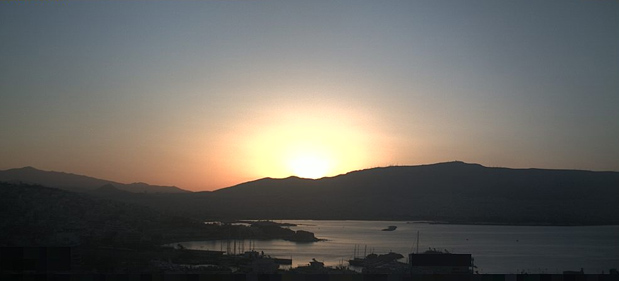
Below: Two images from the live cam at pireas.org
ARCHIVE PAGE - MAY 19 TO MAY 31 2010